







Padel court management has become one of the fastest-growing and highest return on investment (ROI) business models in the sports industry in recent years. Padel, a dynamic mix of tennis and squash, attracts players of all ages thanks to its low learning curve and social interaction-oriented structure.
From a commercial perspective, padel courts offer optimized space usage for operators, as they take up less area than traditional tennis courts and can host more players in the same square meter unit. This provides a great advantage for investors, especially in urban areas where land costs are high.
This branch, which has entered the radar of sports tourism and local sports clubs, creates not just a hobby but also a sustainable commercial ecosystem.
Becoming a global power in sports field construction since 1994, Reform Sports has completed tens of thousands of projects in over 100 countries, ensuring that investors make a professional start to this profitable process. The success of a facility depends on many factors, from the quality of the materials used to the operating vision.
A well-planned facility has the capacity to pay for itself in just a few years.
Is Padel Court Management Profitable?
The question investors are most curious about is the speed of the financial return. Compared to tennis, padel allows four players (doubles match) to play in a much smaller area. This increases the revenue generated per unit square meter. Approximately three courts can fit into a standard tennis court area. This means being able to charge 12 players instead of 4 players in the same time slot. On the demand side, the fact that the game is focused on fun and socialization rather than technical skill ensures that occupancy rates remain high.
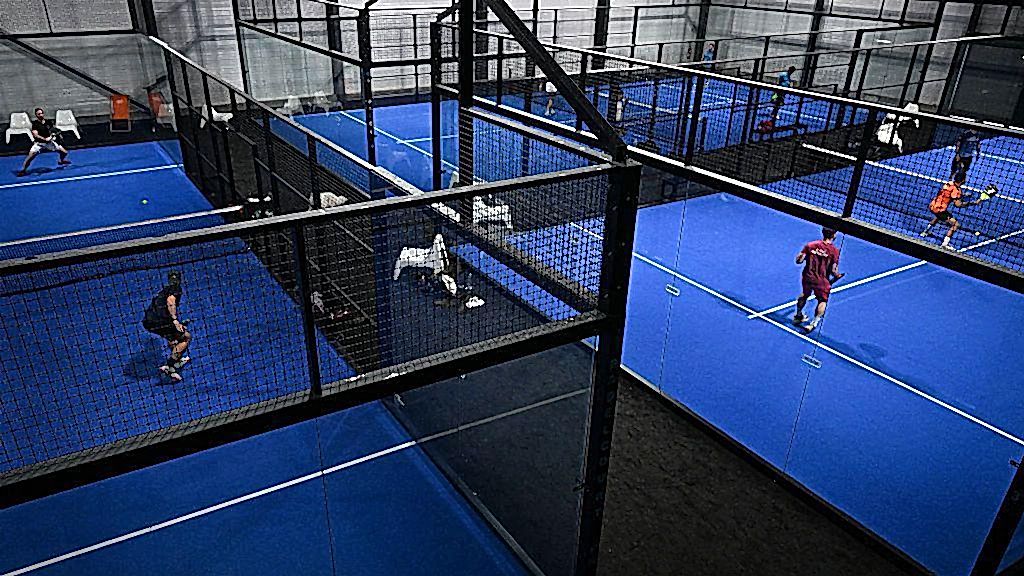
Padel Court
The table below summarizes the main commercial differences between padel court investment and traditional courts:
| Criteria | Padel Court | Tennis Court |
|---|---|---|
| Required Area | 200 m² (10x20m) | ~650 m² (18x36m) |
| Number of Players | 4 People (In limited area) | 2-4 People (In large area) |
| Return on Investment | Fast (1.5 – 3 Years) | Medium / Long |
| Socialization Rate | Very High | Medium |
Another factor affecting profitability is the low operating costs. The maintenance of a modern facility can be managed with reservation software and automated systems rather than personnel. To better analyze the technical advantages of the field and their effects on player comfort, you can take a look at our padel tennis courts and advantages page. As popularity increases, sponsorship revenues also significantly push up the profit margin.
Padel Court Business Revenue Models
A successful sports facility should not limit its revenues only to court rentals. Diversified revenue models stabilize cash flow and provide protection against crisis periods. Especially academies and private lessons are the most effective way to fill the dead hours (weekday mornings and afternoons) of the courts. In addition, tournament organizations provide high turnover with collective participation fees while making the name of the facility known.
- Court Rental: The basic source of income offered in hourly slots.
- Equipment Sales and Rental: Retail profit from the sale of rackets and balls.
- Cafeteria Services: Additional income from social areas after the match.
- Corporate Sponsorships: Brand advertisements placed on the court glass.
While configuring the financial structure of the facility, it is necessary to get a professional breakdown of the padel court cost to clarify the initial expenses. Accurate budgeting will prevent you from encountering unexpected surprises during the operating phase.
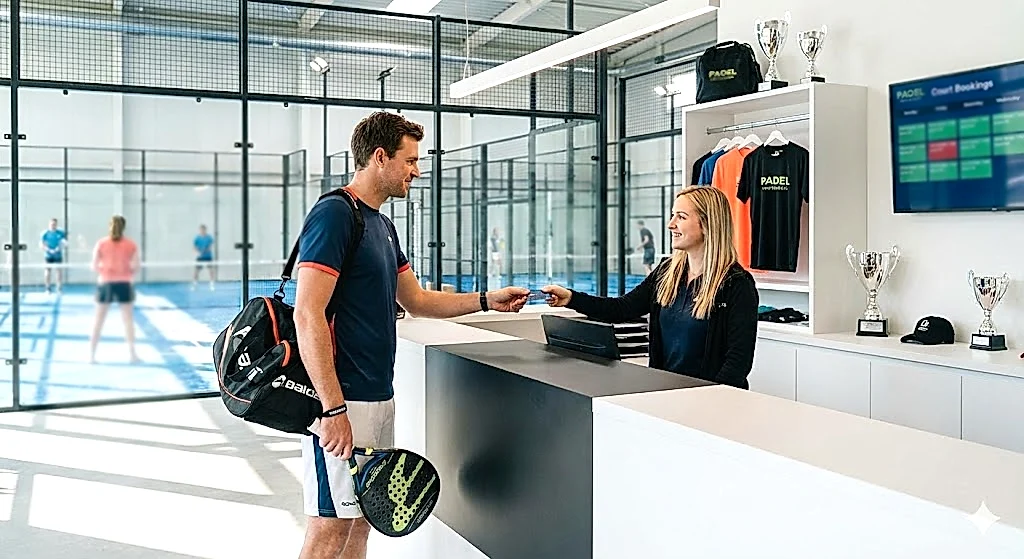
Is a Padel Court Management Venture a Profitable Business?
What is Needed to Turn Padel Court Management into Success?
To make a facility sustainable, the “install and leave” logic should be avoided. The key to success is community management. Making players feel like part of a club increases their return rate. In addition, digital visibility is vital. Online reservation systems should allow users to book a court in seconds via a mobile app. Mini-tournaments organized via social media keep the player base alive at all times.
Things to Consider When Operating a Padel Court
The most neglected issues in the management process are drainage and surface maintenance. The use of poor quality artificial turf can cause professional players to leave your facility by disrupting the bounce characteristics of the ball. Also, the safety of the glass panels should be checked regularly. Player safety is the biggest responsibility of an operator. Sound insulation and landscaping also play a critical role in terms of legal permits and neighborhood relations, especially in facilities close to residential areas.
1. How long does a padel court take to pay for itself?
Depending on the occupancy rate, a return is generally achieved within 1.5 to 3 years.
2. How much space is required to operate a padel court?
A minimum area of 250-300 m² is sufficient for one court and the surrounding margins.
3. Are padel court maintenance costs high?
No, it has low-cost routines other than surface brushing and glass cleaning.
4. Is padel better as an indoor or outdoor court?
Indoor courts can be more advantageous as they offer 12 months of uninterrupted income depending on climate conditions.
5. How many personnel should be employed?
In a small padel facility, one receptionist and one cleaning staff are sufficient.
6. Are padel rackets expensive?
There is a wide price range; the rental model is a profitable side income for the operator.
7. What should the ground type be?
The International Padel Federation recommends sand-filled synthetic grass surfaces as a standard.
8. Is lighting costly?
Energy consumption can be minimized by using modern LED systems.
9. How should the location be chosen?
Areas with a dense young professional population and no parking problems should be selected.
10. Does Reform Sports provide post-installation support?
Yes, Reform Sports is always with you with its global experience in technical service and maintenance.